
Key Takeaways: Grace Plate Benefits
- Grace Plates feature an innovative round design that allows technicians to set alignment after resin lamination, eliminating alignment shifts during curing.
- Post-fabrication hole drilling removes the risk of misaligned 4-hole attachments, reducing costly socket remakes and technician lab bench hours.
- Utilizing specialized plates streamlines the entire prosthetic socket fabrication cycle, enabling faster patient deliveries without sacrificing device quality.
- Partnering with an accredited central fabrication facility gives clinical practices access to state-of-the-art prosthetic design and components without in-house overhead.
_________________________________________________________________________________________________________
Understanding Grace Plate Benefits for Modern O&P Practices
In a busy orthotics and prosthetics clinic, practitioner efficiency directly impacts turnaround times and patient satisfaction. When managing complex clinical cases, facility directors often ask: how do Grace Plates reduce prosthetic fabrication time while maintaining structural integrity?
The answer lies in solving one of the most persistent challenges in socket manufacturing: maintaining perfect alignment during resin lamination.
Traditional square attachment plates require precise alignment before resin is poured. If the component shifts even a fraction of a millimeter during vacuum curing, the entire socket must be scrapped or heavily modified.
Examining key Grace Plate benefits reveals how a simple mechanical innovation radically simplifies this workflow. By replacing rigid square geometries with an adaptable round design, technicians gain post-lamination flexibility.
This allows clinical facilities and central fabrication labs to streamline production, eliminate material waste, and deliver superior outcome consistency.
Eliminating Lamination Errors in Prosthetic Socket Fabrication
The traditional fabrication process requires technicians to carefully position 4-hole adapter plates prior to resin lamination. During the curing phase, resin shrinkage and vacuum pressure can cause the plate to twist out of square.
When this happens, fixing the alignment requires hours of manual modification or a complete re-fabrication of the socket.
Round Grace Plates eliminate this bottleneck entirely. Because the plate geometry is round rather than square, technicians do not need to lock in the final 4-hole rotation beforehand. The plate is laminated directly into the socket wall.
Once the resin cures completely, technicians view the interior of the socket to drill the mounting holes in perfect alignment with the patient’s residual limb.
By allowing technicians to fine-tune component positioning after curing, Grace Plates Prosthetic technology removes guesswork from the shop floor. Eliminating lamination shifts speeds up overall prosthetic socket fabrication lead times while preventing costly material rejections.
Combining Structural Durability with Comfort and Functionality
Speed should never come at the expense of patient safety or device longevity. Every custom prosthetic device must withstand significant daily impact, cyclic stress, and rotational torque.
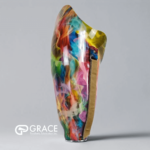
Grace Plates are engineered from high-grade, durable materials that exceed structural demands while keeping total component weight to a minimum.
Innovative hardware components play a crucial role in creating devices that balance strength with user comfort. Because these plates fit smoothly into thin laminate layers, they reduce bulk around the distal end of the limb.
This streamlined profile enhances both comfort and functionality for lower-limb amputees, allowing the finished device to fit comfortably under clothing and integrate smoothly with modern modular alignment components.
Furthermore, integrating advanced central fabrication services technology into the manufacturing workflow ensures every socket meets rigorous quality standards. The combination of custom laminations and engineered adapter plates ensures practitioners deliver a high-quality prosthetic build on time, every time.
Maximizing Clinical Efficiency Through Central Fabrication
For growing O&P practices, maintaining an in-house lab can create significant operational bottlenecks. Technician labor, equipment upkeep, and resin handling consume time that could otherwise be spent in direct consultations.
Outsourcing prosthetic sockets and complete builds to dedicated prosthetics services lets clinics expand their volume while keeping overhead low.
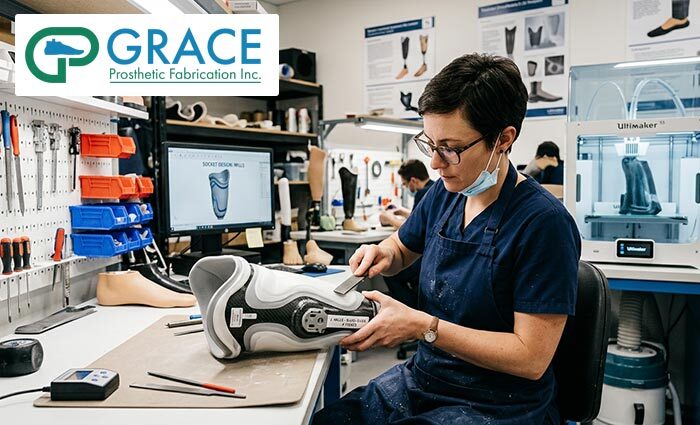
The advanced solutions at Grace Prosthetic Fabrication offer clinicians a seamless partnership. By combining decades of master craftsmanship with central fabrication efficiency, practices gain access to reliable turnaround times without sacrificing precision.
Leveraging professional central fabrication allows certified prosthetists to focus their expertise where it matters most: delivering exceptional patient care and optimizing clinical fit.
When your clinic delegates heavy manufacturing to an experienced partner, you eliminate non-billable bench hours.
Our lab manages every phase of the build with meticulous attention to detail, transforming complex prescriptions into high-performance devices ready for immediate fitting.
Frequently Asked Questions
How does a round plate design differ from a standard 4-hole square plate?
Standard square plates must be aligned perfectly before lamination occurs. If the plate shifts during resin curing, alignment is lost. A round Grace Plate allows technicians to laminate first and drill the 4-hole pattern afterward, guaranteeing accurate positioning every time.
Are Grace Plates compatible with standard modular prosthetic components?
Yes. Grace Plates are designed to accept industry-standard 4-hole pyramid receivers and adapters. They allow clinicians and fabricators to easily attach and fine tune modular components from major manufacturers.
How does outsourcing socket fabrication benefit a clinical practice?
Outsourcing to a dedicated central fabrication laboratory reduces clinic overhead, eliminates material waste, and frees up practitioner time. Clinicians can dedicate more hours to direct patient care while relying on certified technicians for complex manufacturing.
Contact Grace Prosthetic Fabrication Today
If your practice or lab is ready to optimize turnaround times and enhance device durability, team up with an industry leader. Reach out to our team of experts in prosthetic fabrication to learn how our specialized central fabrication services can elevate your clinical outcomes.
To discuss custom socket specifications, explore component options, or set up a business account, we invite you to contact Grace Prosthetic Fabrication today.
Let us help you deliver exceptional comfort and reliability to every patient you serve.